

Structural & Construction
UA Engineering Blog & Insights
How to Compare Handyman Services in Singapore: A Complete Guide to Choosing the Right Provider
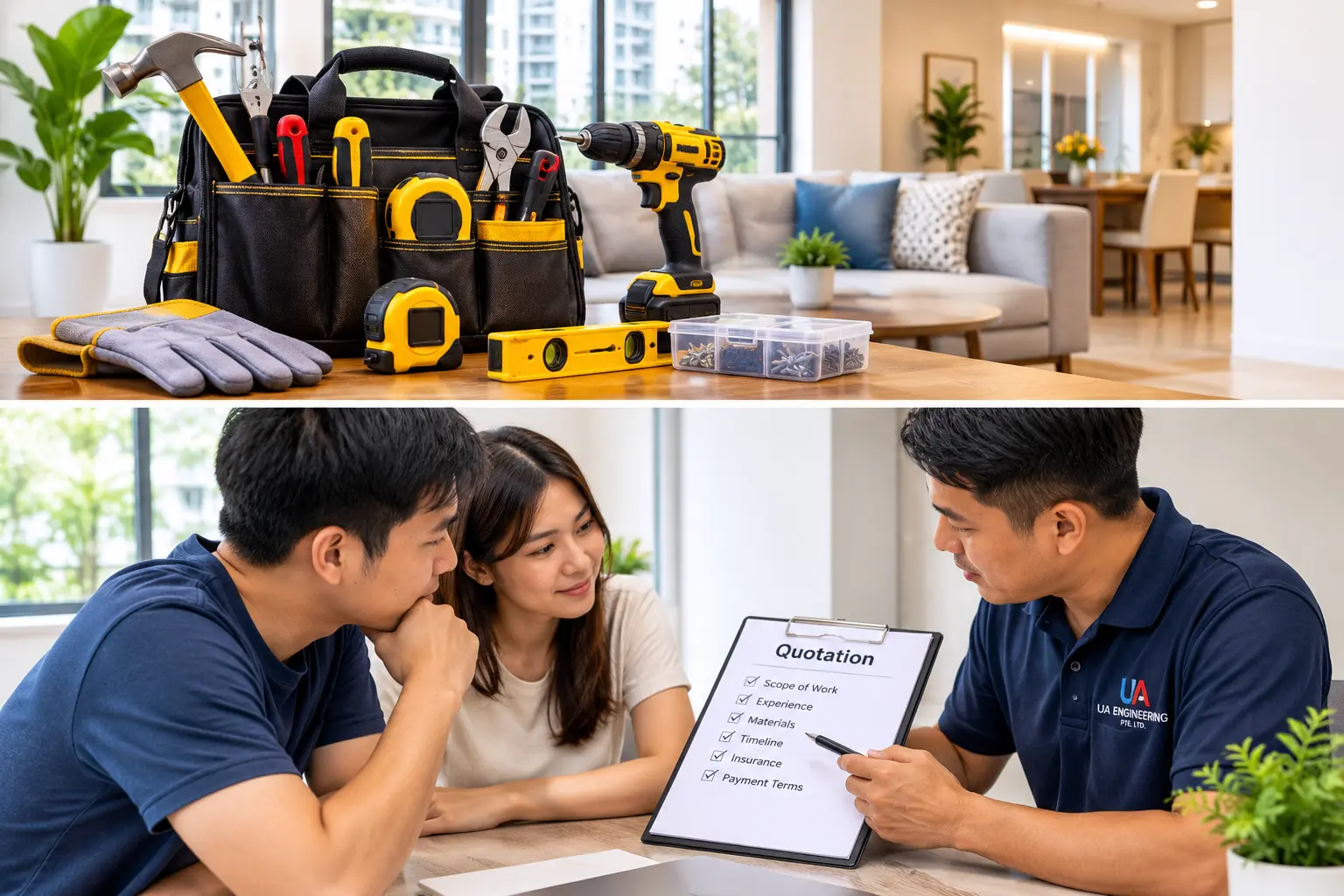
Finding a reliable handyman in Singapore can make everyday home maintenance much easier. From repairing a leaking tap and fixing a door hinge to installing shelves, replacing fittings and carrying out minor touch-ups, a capable handyman can help homeowners resolve small problems before they become bigger inconveniences.
However, not every maintenance provider offers the same services, experience or level of workmanship. Some specialise in general household repairs, while others focus on painting, carpentry, plumbing, electrical work or air-conditioning maintenance. Certain jobs also require licensed professionals or specialist contractors rather than a general handyman.
Choosing based only on the lowest quotation can lead to incomplete work, unexpected charges or repairs that do not last. It is important to compare providers by their service scope, experience, quotations, insurance, communication, references, workmanship and payment terms.
This guide explains how to evaluate handyman providers in Singapore, identify which jobs are suitable for general handyman services and understand when a licensed or specialist professional is necessary.

1. Understand what a handyman service covers
A handyman generally handles minor repairs, basic installations, adjustments and routine maintenance around a home. The exact service range varies by provider, so never assume that every handyman can perform every type of repair.
Common handyman tasks
Depending on their training, experience and equipment, a general handyman may be suitable for:
Tightening loose door handles, hinges and cabinet hardware.
Adjusting doors, drawers and cupboard fittings.
Replacing simple handles, hooks and knobs.
Assembling ready-made furniture.
Installing curtain rods, picture hooks and selected shelves, subject to wall type and safe fixing requirements.
Replacing simple non-electrical accessories.
Repairing minor wall holes, surface cracks and paint touch-ups.
Applying suitable sealant around selected fixtures.
Replacing simple tap accessories or shower hoses where no regulated plumbing work is involved.
Carrying out minor carpentry adjustments.
Installing certain household accessories and fittings according to the manufacturer's instructions.
These are examples, not a blanket permission for every provider. A task that appears simple may become specialist work if it involves concealed wiring, water pipes, structural elements, waterproofing systems, fire-safety equipment or work at height.
When to use a specialist
Some jobs require a licensed professional, a specialist contractor, a permit or approval from a property authority or management office. A general handyman should not undertake regulated work merely because they have done similar jobs before.
Before accepting a quotation, identify the actual task and ask who will carry it out. If the work is regulated, confirm the person's licence or qualification and whether any submission, inspection or certification is required.
2. Distinguish handyman work from licensed and specialist work
This is one of the most important checks when comparing providers in Singapore. The right provider is not simply the person who says they can do the job; it is the person who is competent and authorised to do it.
Electrical work
A handyman may be able to help with non-electrical tasks such as mounting a cable cover or installing a suitable accessory without modifying the electrical installation. However, electrical wiring, circuit modifications, adding or relocating power points, distribution-board work and other regulated electrical installations should be handled by an appropriately licensed electrical worker.
For electrical work, ask the provider for the licensed worker's details and clarify whether testing, certification or other documentation is required. Do not accept an informal assurance that the work is safe simply because the lights turn on.
Official reference: Energy Market Authority (EMA) - Engaging Licensed Electrical Workers.
Plumbing and water services
A handyman may be suitable for certain simple maintenance tasks, such as replacing a shower hose or cleaning an accessible drain trap, if the task does not involve regulated plumbing work.
Work involving water-service installations, sanitary plumbing, pipe alterations or other regulated activities may need to be carried out by a PUB Licensed Plumber. Ask whether the job falls within regulated plumbing work before booking.
Official reference: PUB - Licensed Plumbers and Plumbing Works.
Air-conditioning servicing and repair
Basic cleaning of accessible filters may be suitable for a homeowner or maintenance provider, depending on the equipment manufacturer's instructions. However, refrigerant handling, leak repairs, electrical diagnosis, major component replacement and complex system work should be assigned to an appropriately trained air-conditioning specialist.
For multi-split or central systems, check whether the provider has experience with the equipment type and can provide service records. Do not let an inexperienced worker open refrigerant circuits or perform electrical work.
Structural and building alterations
Removing walls, altering structural components, modifying beams or columns, changing building elements and undertaking major additions or alterations are not ordinary handyman tasks. These works may require assessment, submissions, approvals and supervision by qualified professionals.
For structural work, consult the Building and Construction Authority (BCA) and appoint the relevant Qualified Person where required.
Windows, glazing and work at height
Window replacement, window safety components, façade work, glass installation and external access work can involve specific safety and regulatory requirements. Do not treat these as routine handyman jobs.
For HDB flats, check HDB's requirements and approved contractor arrangements before engaging anyone for window-related work. Work at height should be performed with appropriate access equipment, risk controls and competent personnel.
Waterproofing and leak investigation
A handyman may be able to renew a small bead of accessible sealant, but persistent water leakage, bathroom seepage, roof leaks and dampness inside walls need proper diagnosis. Covering a stain or applying surface sealant without identifying the source can allow damage to continue.
For significant or recurring leakage, use a contractor experienced in waterproofing and leak investigation. Ask for the proposed repair method, preparation requirements, testing procedure and warranty terms.
Fire-safety systems
Work involving fire alarms, sprinklers, emergency lighting, fire doors or other regulated fire-safety systems should be handled by suitably qualified or approved specialists. These systems protect occupants and must not be disconnected, altered or obstructed by an unqualified worker.
A useful rule: If a task involves regulated installations, structural integrity, fire safety, concealed services or significant risk to people and property, pause and verify the required professional before proceeding.
3. Compare providers by their service scope
Once you understand the task, compare providers based on whether they can complete the full job safely and properly. A provider who advertises “all types of handyman services” may still outsource specialist work or exclude important parts of the job.
Ask exactly what is included
Describe the problem clearly and ask the provider to confirm the work they will perform. For example, if a kitchen cabinet door is loose, does the service include adjusting the hinges, replacing damaged screws, supplying new hinges if needed and checking the remaining doors?
For a wall repair, does the quotation include filling, sanding, primer, paint matching and final touch-up? If the provider only fills the hole, you may need to arrange painting separately.
Ask whether the quotation includes:
Inspection or diagnosis of the problem.
Labour and estimated time on site.
Materials, consumables and replacement parts.
Removal and disposal of damaged components.
Protection of floors, furniture and nearby surfaces.
Testing and clean-up after the repair.
A workmanship warranty or return visit if the repair fails.
Clarify exclusions too. A provider may quote to replace a tap but exclude the cost of a new tap, damaged pipe repair, access work or additional fittings. These exclusions are not necessarily unreasonable, but you should know about them before agreeing.
Check whether the provider handles the whole job
Some jobs involve more than one trade. A leaking ceiling, for example, may require leak investigation, plumbing or waterproofing repairs, and repainting after the surface has dried. Repainting the ceiling alone may hide the stain temporarily without solving the source.
Ask whether the provider will coordinate the necessary specialist or whether you must appoint another contractor. If a specialist is involved, identify who is responsible for the work, payment, testing and warranty.
4. Evaluate experience and technical knowledge
A provider's experience should be relevant to your particular repair. The number of years in business can be useful, but it does not prove that the person has the skills or equipment for every job.
Look for task-specific experience
Ask how often the provider carries out the type of work you need. Someone who regularly installs shelves may understand wall plugs, fixing methods and load limits. Someone who mainly assembles furniture may not be experienced in repairing a damaged wall or identifying concealed services.
Useful questions include:
Have you completed similar jobs in Singapore homes?
What is the likely cause of this problem?
What repair method do you recommend, and why?
What materials or replacement parts will you use?
Are there risks or limitations I should know about?
Will you perform the work yourself or send a subcontractor?
Does this task require a licensed or specialist professional?
A capable provider should be able to explain the work in plain language. Be cautious if someone recommends an expensive replacement without inspecting the problem or cannot explain why a particular repair is necessary.
Consider property-specific experience
Singapore homes vary in age, layout and construction. An older HDB flat may have different fittings, concealed services and wall conditions from a recently completed condominium. Landed homes may involve external areas, roof access, drainage or more complex building components.
Ask whether the provider has worked in your property type and understands its relevant restrictions. HDB owners should also distinguish ordinary household maintenance from renovation work subject to HDB's contractor and approval requirements.
HDB's Professional Help and Contractors guidance explains that homeowners can engage contractors for household repairs, while licensed workers and plumbers should be engaged for electrical and sanitary works. HDB also identifies approved contractors for certain window maintenance and trained professionals for air-conditioning maintenance.
Housing & Development Board
5. Compare quotations carefully, not just the total price
A quotation is more than a price. It is a written description of what the provider promises to do, what materials are included and how much you will pay.
Obtain two or three quotations where practical, particularly for work involving multiple tasks, costly materials or a significant amount of labour. For a very small repair, a formal competitive process may be unnecessary, but you should still ask for the call-out fee and likely total cost.
What a good quotation should contain
A clear quotation should state:
Description of work: The repair or installation to be carried out.
Labour charges: Whether labour is charged by the hour, by the task or as a fixed amount.
Materials: The products, parts, quantities and specifications included.
Transport or call-out fees: Any minimum charge, travel fee or inspection fee.
Additional charges: Possible costs for difficult access, concealed damage or extra work.
Estimated duration: How long the job is expected to take.
Payment terms: Deposit, progress payment or payment after completion.
Warranty: What is covered, for how long and what is excluded.
Validity period: How long the quoted price remains available.
If the provider gives only a verbal estimate, ask for written confirmation by email or message before accepting. A written record helps prevent disagreements over what was agreed.
Compare like for like
Imagine three providers quote for repairing a damaged bedroom door. One offers a low price to adjust the hinges only. Another includes hinge replacement and alignment. A third proposes replacing the entire door, including hardware and disposal.
The lowest amount may not represent the same service. Compare the proposed repair method, parts, finish and expected result.
Likewise, for painting touch-ups, check whether the provider includes surface preparation, primer, paint, colour matching and protection of nearby surfaces. A cheap quote that excludes preparation may produce a poor finish.
Watch for unusually low or vague prices
A very low quotation may be legitimate, but it deserves clarification. The provider may have excluded materials, underestimated labour, misunderstood the task or intend to charge for additional work later.
Ask what could cause the price to change. Agree that additional work must be explained and approved before it is carried out. Avoid providers who pressure you to pay immediately or refuse to put the agreed price in writing.
6. Check insurance and responsibility for damage
Insurance is an important consideration, especially where a job involves drilling, heavy equipment, work at height, access to common areas or the possibility of damaging neighbouring property.
Do not assume that every individual handyman has the same insurance cover. The type of cover required or appropriate depends on the provider's business arrangement, the work, the property and any management or contract conditions.
What to ask about
For larger or higher-risk jobs, ask whether the business has relevant public liability insurance and whether its policy covers the proposed work. If workers are employed, ask whether the business meets applicable work-injury compensation requirements. For condominium or managed developments, check whether the management office requires insurance documents before work can begin.
You can ask for confirmation of:
The name of the insured business.
The type of insurance held.
The policy's period of validity.
Whether the work being proposed is within the policy scope.
Any relevant limits, exclusions or conditions.
Whether subcontractors are covered or need separate arrangements.
A certificate of insurance or policy summary can help you understand the cover, but do not assume that a document guarantees every possible claim will be accepted. If the work is substantial, ask the property manager or an insurance professional what evidence is required.
Clarify responsibility for damage
Before work begins, agree how the provider will protect your home and what happens if the work damages floors, walls, furniture, fittings or common property.
Take photographs of the work area before the appointment. For work in a condominium or HDB block, clarify who is responsible for protecting lifts and corridors and cleaning up any debris.
Insurance is not a substitute for safe working practices, proper qualifications or a clear contract. A provider should still explain how the job will be carried out safely.
7. Assess communication and professionalism
Good communication is one of the strongest indicators of a well-managed service. A technically capable handyman can still create problems if appointments are missed, costs are not explained or messages go unanswered.
Evaluate the first interaction
Notice how the provider responds to your initial enquiry. Do they ask relevant questions, request photographs or suggest a site inspection when necessary? Do they explain what information they need before giving a price?
A reliable provider should communicate:
What information is needed to assess the task.
Whether a site visit is necessary.
The expected arrival time and service duration.
What you should prepare before the appointment.
Whether materials will be supplied by the provider.
How changes or unexpected findings will be handled.
When payment is due and what records you will receive.
Look for clear, realistic commitments
A provider who promises to fix every problem immediately without inspecting it may be overconfident. A professional should be willing to explain uncertainty, especially where the cause of a leak, electrical fault or recurring defect is not obvious.
Ask for a message confirming the appointment date, estimated arrival window, address, agreed task and quoted charges. If the provider needs to reschedule, they should notify you as early as reasonably possible.
Avoid poor communication patterns
Be cautious if a provider repeatedly changes the price without explanation, refuses to answer reasonable questions, pressures you to make a decision, or avoids written confirmation.
You should feel comfortable asking questions. A trustworthy provider will understand that homeowners need to know what work is being performed and what they are paying for.
8. Check references, reviews and previous work
Reviews and references help you assess a provider's reliability, but they should not be your only selection criteria.
Read reviews critically
Look for repeated comments about punctuality, workmanship, cleanliness, pricing transparency and after-service support. A pattern of similar complaints may be more informative than one unusually positive or negative review.
Check whether reviews refer to the same type of service you need. A provider may receive excellent feedback for furniture assembly but have limited experience with painting or plumbing.
Be cautious about profiles with very few reviews, generic comments or repeated wording. Reviews can be useful indicators, but they are not proof of licensing, insurance or technical competence.
Request relevant photographs
Ask for before-and-after photographs of similar jobs, where available. Look for details such as neat finishing, alignment, clean sealant lines, properly installed fittings and tidy work areas.
For jobs involving complex repairs, photographs may not show the quality of concealed work. Ask whether the provider can explain the repair method and provide relevant test records or documentation.
Ask for a reference when appropriate
For larger jobs, ask whether the provider can share a previous customer's reference with their permission. You might ask whether the provider arrived on time, stayed within the agreed price, completed the work properly and returned to resolve any defects.
Respect the privacy of previous customers. A reputable provider should not disclose personal contact details without permission.
9. Evaluate workmanship and the repair method
A completed job should be safe, functional, neat and suitable for its intended use. A repair that looks acceptable on the day may still fail if the underlying cause has not been addressed.
Check preparation and materials
For painting, check whether the provider will clean, fill, sand and prime the surface as required. For sealant work, confirm that the old material will be removed where necessary and the surface prepared according to the product instructions.
For shelves and wall-mounted fittings, ask how the provider will identify the wall type and choose suitable fixings. The correct fixing depends on the substrate, load and installation conditions. Drilling without checking for concealed services can cause damage or create a safety hazard.
For door and cabinet repairs, check whether the provider will inspect the hinge, frame, screws and alignment rather than simply tightening one component.
Inspect the completed work
After the repair, check that the item operates as intended. Open and close doors and drawers, test installed fittings, look for visible damage and confirm that the work area has been cleaned.
For repairs involving plumbing, observe the relevant fittings for leaks and check that drainage works properly. For regulated electrical work, ask the licensed electrical worker about the required testing and documentation rather than relying on a basic visual check.
Ask about workmanship warranties
A warranty should explain what is covered, how long it lasts and what the provider will do if the repair fails. Ask whether it covers labour, materials or both.
Understand the exclusions. A warranty for a replaced hinge may not cover damage caused by later impact or misuse. A sealant repair may not cover a leak originating from another part of the building.
Get warranty terms in writing, even if the job is relatively small.
10. Understand payment terms before booking
Payment arrangements should be proportionate to the size and complexity of the job. A small repair may be payable after completion, while a larger maintenance project involving special-order materials may require an agreed deposit.
Agree on the payment structure
Before confirming the appointment, ask:
Is there a call-out or inspection fee?
Is the quotation fixed or an estimate?
When is payment due?
Are materials included in the quoted amount?
Is a deposit required, and what does it cover?
Will additional work require written approval?
Will you receive an invoice or receipt?
For a small job, payment after satisfactory completion is often straightforward. For a larger job, agree on reasonable milestones linked to work completed or materials supplied.
Avoid paying the entire amount upfront unless there is a clear, documented reason and you understand the risks. If a deposit is required, make sure the amount, purpose and refund conditions are recorded.
Use traceable payment methods
Where possible, pay through a method that produces a transaction record. Keep the quotation, invoice, payment confirmation and messages about any changes.
Be careful if a provider asks you to transfer money to an unrelated personal account without explaining why, refuses to issue a receipt or demands extra payment that was never agreed.
Confirm additional charges
Unexpected work may be necessary after inspection. For example, a loose shelf may reveal damaged wall material, or a leaking fitting may have a worn connection that needs replacement.
Ask the provider to stop and explain the additional work before proceeding. Request a revised price and agree on the change in writing. This protects both parties from disputes.
11. Consider your property type and management requirements
The type of home can affect which provider you should engage and what procedures must be followed.
HDB flats
For ordinary household repairs, HDB states that owners may engage contractors, but it advises using licensed workers and plumbers for electrical and sanitary works. HDB also identifies approved window contractors and trained professionals for air-conditioning maintenance.
Housing & Development Board
If a job forms part of a wider renovation, do not assume it is ordinary handyman maintenance. HDB requires owners to use contractors listed in its Directory of Renovation Contractors for renovations covered by its rules. Specific works may require HDB approval or appropriately licensed workers.
For example, HDB's renovation guidance identifies PUB Licensed Plumbers for regulated water-service and sanitary works, EMA-licensed workers for electrical installations and BCA-approved window contractors listed with HDB for relevant window work.
Housing & Development Board+1
Check the current requirements at HDB-Application for a Renovation Permit.
Condominium apartments
Condominium management offices may require advance registration, renovation or maintenance applications, insurance documents, contractor details, deposits and specified working hours.
Even for a relatively small repair, check whether drilling, external access, lift use or work affecting common property needs prior permission. A handyman should not alter shared pipes, façades, fire-safety systems or other common property without the necessary authorisation.
Landed properties
Landed-property owners may have more freedom for some maintenance tasks, but work involving roofs, structural elements, drainage, external walls, boundary structures and additions or alterations can require specialist assessment and regulatory approval.
For major building or structural work, consult BCA or the relevant authority and appoint qualified professionals where required. A general handyman should not be used as a substitute for a structural specialist or licensed trade professional.
12. Follow a simple process when hiring a handyman
A consistent process makes it easier to compare providers and reduces the risk of misunderstandings.
Step 1: Describe the problem
Write down what needs attention, where it is located and when the issue started. Take clear photographs or a short video. Mention any previous repair attempts and whether the problem is getting worse.
Step 2: Identify the right type of provider
Decide whether the job is a simple repair, a multi-trade maintenance task or regulated specialist work. If you are unsure, ask a qualified professional or the relevant authority before booking.
Step 3: Request comparable quotations
Send the same description and photographs to each provider. Ask for the same scope, materials, call-out fees and expected timing so that the quotations can be compared fairly.
Step 4: Verify the provider
Review experience, references, relevant licences, insurance where applicable and the provider's ability to explain the proposed method.
For regulated electrical work, verify the person's EMA licence. EMA explains that electrical wiring installation, repair or modification, and the addition or replacement of power points should be carried out or supervised by a Licensed Electrical Worker. Its official guidance also explains how to check a worker's licence.
EMA+1
For regulated plumbing, PUB explains which tasks require a Licensed Plumber and lists specific simple plumbing works that a handyman without a licence may perform. See PUB-Plumbing Works.
PUB, Singapore's National Water Agency
Step 5: Confirm the appointment in writing
Record the task, price, materials, date, arrival window, payment terms and any exclusions. If the provider will bring a specialist or subcontractor, confirm who is responsible for the work.
Step 6: Prepare the work area
Move fragile items, clear access to the repair location and secure pets or children away from the work area. For condominium or HDB properties, arrange any required access or management approval.
Step 7: Inspect and close the job
Check the completed work, ask questions about maintenance and collect the invoice or receipt. If something is incomplete, record it and agree on a return visit or rectification date.
13. First-time homeowner checklist for choosing a handyman
Use this practical checklist when comparing providers. You can tick each item as you complete it.
Handyman Hiring Checklist
Before contacting providers
Describe the repair and identify its location
Take clear photographs or videos of the problem
Decide whether the work may require a licensed specialist
Check any HDB or condominium management requirements
When comparing providers
Confirm the provider offers the exact service required
Ask about experience with similar repairs and property types
Request an itemised quotation and clarify call-out fees
Check materials, labour, exclusions and estimated duration
Ask about insurance where appropriate and required
Review relevant references, reviews and previous work
Confirm who will carry out the work and any subcontracting
Before accepting the quotation
Compare quotations based on the same scope
Confirm the price and additional-work approval process
Agree on payment milestones, deposit and refund terms
Confirm workmanship warranty and exclusions
Save written confirmation of the appointment
After the work
Inspect the completed repair and test its function
Check the work area is clean and undamaged
Collect the invoice, receipt and warranty details
Record any defects and agree on rectification dates
Copy checklistReset
14. Common mistakes to avoid when choosing a handyman
Even when a repair looks straightforward, a poor hiring decision can lead to repeated visits, additional expenses or damage.
Choosing only by price: A cheaper quotation may exclude materials, preparation or clean-up. Compare the actual scope and expected result.
Assuming every handyman is qualified for every job: General repair experience does not replace a required licence or specialist qualification. Verify the person who will perform regulated work.
Accepting verbal agreements: A written description of the task, price and exclusions helps prevent disagreements.
Ignoring recurring problems: Repainting a damp wall or repeatedly applying sealant may conceal a leak without repairing its cause. Investigate the underlying issue.
Failing to check access and property rules: Drilling, external work, common-area access and noisy maintenance may be restricted by HDB or condominium rules.
Paying everything before completion: Use payment terms appropriate to the job and keep records. For larger work, link payments to agreed milestones.
Not inspecting the result: Test the repair before closing the job and record any defects promptly.
15. Official Singapore resources for homeowners
The following official resources can help you verify provider requirements and understand when specialist professionals are necessary.
HDB-Professional Help and Contractors: Guidance on household repairs, licensed trades, window contractors and air-conditioning maintenance.
HDB -Renovation Permit Application: HDB renovation requirements and the contractor directory.
EMA - Engaging Licensed Electrical Workers: Electrical work that needs a licensed worker and how to verify a licence.
PUB-Licensed Plumbers and Plumbing Works: Regulated plumbing work and the specific simple tasks that handymen may perform.
BCA -Building and Construction Authority: Information on building safety, approved contractors and regulated building work.
MOM-Workplace Safety and Health: Workplace safety guidance relevant to contractors and work activities.
CASE-Consumers Association of Singapore: Consumer advice and information about resolving disputes.
Always check the latest requirements and confirm whether they apply to the exact task and property. The fact that a job is small does not automatically mean that it is exempt from licensing or approval rules.
Conclusion
Choosing a reliable handyman in Singapore is about finding the right provider for the right task. Compare the exact service scope, relevant experience, itemised quotations, insurance where appropriate, communication, references, workmanship and payment terms. Do not make your decision based on price alone.
For simple household repairs, an experienced handyman can be a convenient and cost-effective choice. For regulated electrical and plumbing work, structural alterations, fire-safety systems, window-related work and other specialist tasks, engage the appropriately licensed or qualified professional.
Before booking, get the work and price confirmed in writing, clarify exclusions and agree on how additional work will be handled. After completion, inspect the result and keep your payment and warranty records.
A little care when selecting a provider can save time, reduce avoidable costs and help keep your home safe, functional and well maintained
Recent Articles

Why Homeowners Need a Reliable Partner for Renovation and Upgrading
November 12, 2026
Why Is Paint Peeling Off Exterior Walls, and What Should You Do?
November 11, 2026
Steel Fabrication and Installation in Singapore: Applications, Quality and Safety Guide
November 10, 2026
The Final Renovation Inspection Checklist Every Homeowner Needs
November 9, 2026
How to Create a Realistic Home Renovation Budget in Singapore
November 8, 2026
How to Compare Renovation Quotations in Singapore: A Practical Guide for Homeowners
November 7, 2026
Home Renovation Mistakes That Can Cost Time and Money
November 5, 2026
Handyman vs Renovation Contractor vs Specialist Tradesperson: Who Should You Hire?
November 4, 2026
How to Plan a Home Renovation in Singapore: A Complete Guide for HDB, Condo and Landed Homeowners
November 3, 2026