

Others
UA Engineering Blog & Insights
Handyman vs Renovation Contractor vs Specialist Tradesperson: Who Should You Hire?

Choosing the right professional for a home improvement project can save time, prevent unnecessary expenses and help protect your property. In Singapore, homeowners can choose from handymen, renovation contractors and specialist tradespeople. Although their services may overlap, their responsibilities, technical expertise and regulatory requirements are different.
A handyman is generally suitable for small repairs and routine maintenance. A renovation contractor is better suited to projects involving several work activities, planning and coordination. A specialist tradesperson is the right choice when a job requires specific technical knowledge, equipment or a regulated licence.
The challenge is knowing where one role ends and another begins. For example, a small paint touch-up may be a straightforward handyman task, while repainting an entire landed property may require a painting team and careful project coordination. Replacing a tap may be simple, but altering water pipes or electrical wiring can require a licensed professional.
This guide explains the differences, compares typical project scopes and helps Singapore homeowners decide whom to engage for repairs, painting, plumbing, electrical installations and major renovations..

1. What Does a Handyman Do?
A handyman provides general repair, installation and maintenance services for everyday property issues. The role is usually focused on smaller jobs that can be completed without extensive design work, structural changes or coordination between several trades.
Typical handyman tasks may include:
Fixing loose cabinet handles, hinges and door hardware.
Adjusting doors and replacing simple fittings.
Installing shelves, curtain rods and selected household accessories.
Touching up small areas of paint.
Replacing certain taps, showerheads or flexible hoses where regulations allow.
Assembling furniture and carrying out minor non-structural repairs.
Clearing simple blockages and carrying out basic maintenance.
Replacing selected light fittings or accessories only where the work does not involve regulated electrical installation work.
The exact scope depends on the worker’s skills, tools, experience and applicable regulations. The word handyman is not a licence or proof that someone is authorised to carry out every type of repair.
When is a handyman the right choice?
A handyman is often suitable when:
The job is relatively small and clearly defined.
Only one or two simple tasks are required.
No structural alteration is involved.
The work does not require a regulated trade licence.
You do not need a project manager to coordinate several contractors.
For example, if a bedroom door does not close properly because its hinges are loose, a handyman may be able to adjust the hinges. If a few small areas of wall paint have been scratched, a handyman with painting experience may be able to complete a touch-up.
However, if the problem involves a damaged door frame, water penetration, extensive wall deterioration or a larger area requiring surface preparation and repainting, a more specialised service may be appropriate.
Advantages and limitations
Advantages
Suitable for small jobs and routine maintenance.
Often involves a simpler scope of work.
Can be convenient when several minor tasks need attention.
May be more practical than engaging a full renovation team for a small repair.
Limitations
May not have the expertise or equipment for complex technical work.
Usually does not manage a large renovation programme.
May need to refer regulated or specialist work to qualified professionals.
Should not be assumed to hold trade licences simply because they offer repair services.
2. What Does a Renovation Contractor Do?
A renovation contractor manages and carries out property improvement projects that involve a broader scope of work. Instead of focusing on one isolated repair, the contractor may be responsible for planning, scheduling, materials, labour, site coordination and the overall completion of a project.
Depending on the company and project, renovation work may include:
Home, kitchen and bathroom renovation.
Floor replacement, tiling and polishing.
Wall preparation, painting and finishing.
Carpentry, partitions and built-in storage.
Aluminium windows, doors and glazing.
Ceiling and lighting-related coordination.
Waterproofing and selected structural or exterior improvements.
Coordination of plumbing, electrical and air-conditioning trades.
A renovation contractor may use its own workforce, subcontractors or a combination of both. The homeowner should understand who is responsible for each part of the work and which professionals will perform regulated activities.
When should you hire a renovation contractor?
Consider a renovation contractor when the project involves:
Several rooms or areas of a property.
Multiple trades working in a planned sequence.
A kitchen or bathroom upgrade.
Flooring, painting, carpentry and other combined works.
Significant changes to the layout or appearance of a property.
A need for one main contact to coordinate the project.
For example, renovating a kitchen may involve removing old cabinets, preparing surfaces, installing new cabinets, coordinating plumbing connections, arranging electrical work and completing finishing tasks. These activities need to be planned in the correct order.
A renovation contractor can coordinate the overall programme, but regulated work must still be undertaken by the appropriately licensed person where required.
Main responsibilities
A renovation contractor may be responsible for:
Site assessment: Reviewing the existing property and understanding the client's requirements.
Scope planning: Defining the work areas, materials, specifications and exclusions.
Quotation: Preparing an itemised quotation with labour, materials and other charges.
Scheduling: Planning the sequence of work and coordinating different trades.
Site management: Monitoring access, work progress, housekeeping and safety arrangements.
Quality checks: Reviewing completed work against the agreed scope.
Handover: Addressing outstanding items and handing over the completed project.
The exact responsibilities should be written into the contract. A contractor's title alone does not guarantee that every item, approval or specialist service is included.
What credentials should you check?
For HDB flat renovation works, homeowners must engage a contractor registered with HDB's Directory of Renovation Contractors (DRC). The relevant renovation permit must also be obtained before work that requires approval begins. HDB's directory helps homeowners identify contractors familiar with its renovation requirements, but HDB does not guarantee the quality of their work.
For other building works, check whether the proposed scope requires a BCA-licensed builder, a Qualified Person, a Professional Engineer or other approvals. Do not assume that every renovation company needs the same registration for every type of project. Requirements depend on the work, property and applicable exemptions.
3. What Does a Specialist Tradesperson Do?
A specialist tradesperson focuses on a particular trade or technical discipline. This professional may have specific training, experience, tools and licences relevant to the work.
Examples include:
Licensed electricians.
PUB Licensed Plumbers.
Air-conditioning technicians.
Waterproofing specialists.
Aluminium and glazing installers.
Painters and coating specialists.
Steel fabricators and installers.
Tiling and flooring specialists.
A specialist is particularly important when a job involves technical risks, regulated systems, specialised materials or a need for trade-specific testing and workmanship.
When should you hire a specialist?
Engage a specialist when the work requires:
A specific trade skill or technical diagnosis.
A regulated licence or formal authorisation.
Specialist tools, testing or installation methods.
Workmanship that depends on product-specific knowledge.
A technical solution to a recurring or complicated problem.
For example, a recurring water leak may require a waterproofing specialist to identify the source, assess the substrate and recommend a suitable system. Repainting over a damp wall without addressing the underlying moisture problem may only hide the symptoms temporarily.
Similarly, electrical rewiring should not be treated as a general handyman task. It requires an appropriately licensed electrical worker.
Specialist responsibility
A specialist tradesperson is generally responsible for the agreed work within their trade. This may include inspection, diagnosis, recommendations, installation, repair, testing and documentation where applicable.
A specialist may work directly for a homeowner or be appointed by a renovation contractor. When several specialists are involved, clarify who coordinates their work and who is responsible for resolving clashes between trades.
4. Comparing the Three: Scope, Suitability and Coordination
The main difference is the scale and nature of responsibility.
Handyman: Handles individual small repairs and maintenance tasks.
Renovation contractor: Manages a broader project involving planning and multiple activities.
Specialist tradesperson: Performs technical work within a particular trade.
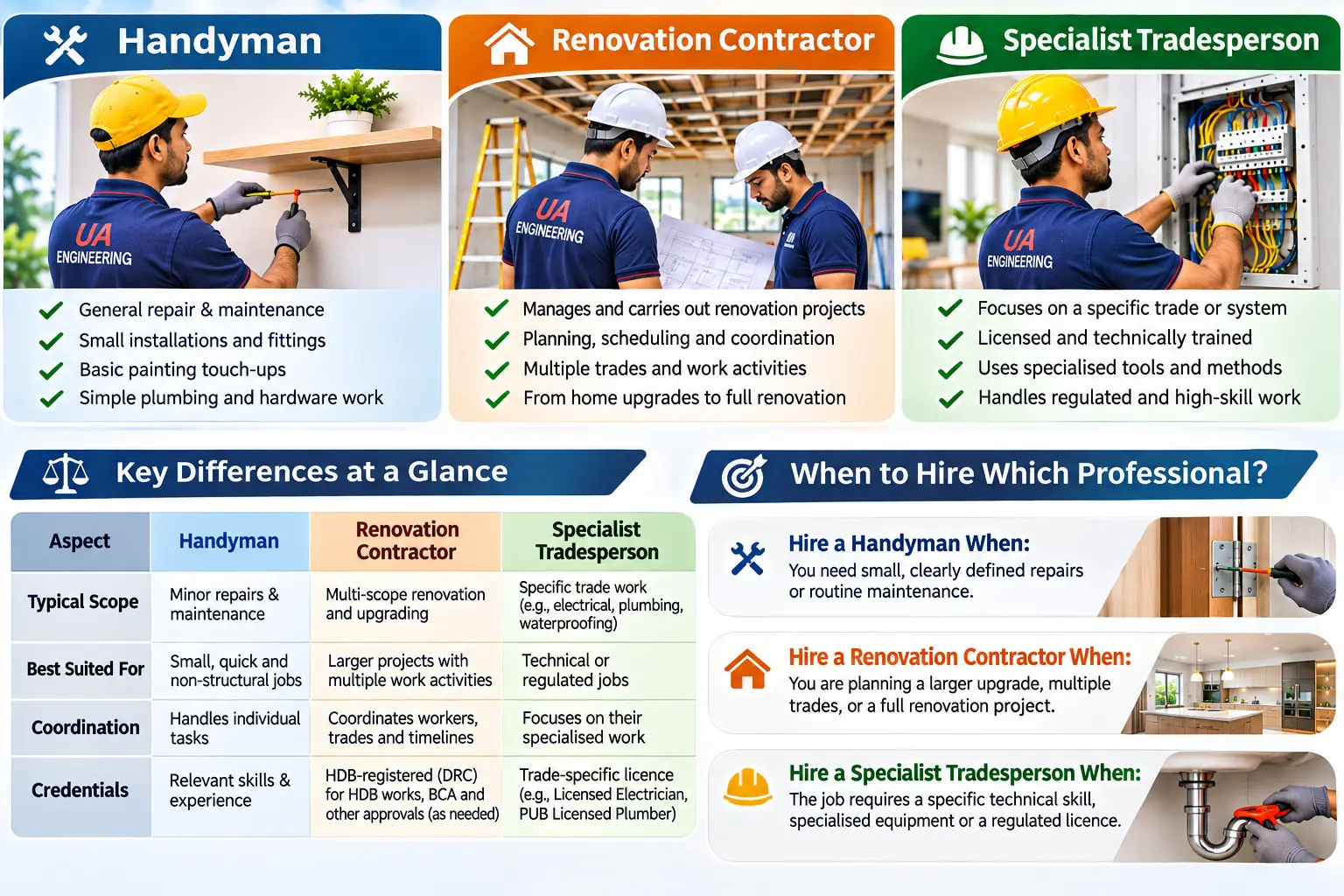
The table is a general guide, not a substitute for checking the actual scope and regulatory requirements. A contractor may also employ specialist tradespeople, and a specialist company may manage a larger package of work.
5. Who Should You Hire for Painting Work?
The right choice depends on the size, condition and complexity of the painting project.
Small paint touch-ups
A handyman with suitable painting experience may be appropriate for a small scratch, minor mark or limited area of peeling paint, provided the surface is sound and the cause of the damage is understood.
Full-room or whole-property painting
A painting contractor or renovation contractor with an experienced painting team is generally more suitable for larger projects. The work may involve:
Protecting floors, furniture and fixtures.
Removing loose or peeling paint.
Repairing cracks and surface defects.
Applying suitable primer.
Selecting the correct paint system.
Applying finishing coats.
Checking coverage and workmanship.
Exterior painting
Exterior painting often requires more preparation and planning than a small interior touch-up. Depending on the building, it may involve access arrangements, cleaning, removal of deteriorated coatings, crack treatment, weather-resistant materials and safety controls.
For a landed property or larger building, choose a contractor with relevant exterior painting experience and a clear method statement. Ask how access, surface preparation, protection and quality inspections will be managed.
6. Who Should You Hire for Plumbing Repairs?
Plumbing work ranges from simple fixture replacement to regulated water-service and sanitary plumbing works. The distinction matters in Singapore.
Simple plumbing tasks
PUB permits handymen without a plumbing licence to carry out specified simple plumbing works. Examples include replacing or removing certain taps and mixers, showerheads, shower hoses and some accessories. The permitted list also includes selected sanitary fixture and blockage-clearing activities.
Do not assume that every plumbing task is classified as simple work. Check the exact activity against PUB's current guidance.
Regulated plumbing work
Water-service and sanitary plumbing works outside the permitted simple-work categories must be carried out by a PUB Licensed Plumber. Examples of regulated activities can include laying, installing, altering, repairing or replacing water pipes and sanitary piping systems.
For a recurring leak, pipe relocation, major bathroom plumbing alteration or a new plumbing installation, confirm whether a Licensed Plumber is required before appointing anyone.
Practical hiring advice
Ask the service provider to explain:
Where the leak or blockage is believed to originate.
Whether the proposed work is simple or regulated.
Whether a PUB Licensed Plumber is required.
What materials and replacement parts are included.
Whether testing and reinstatement are part of the quotation.
A low-cost repair may not be good value if it does not address the underlying problem.
7. Who Should You Hire for Electrical Installations?
Electrical work requires particular care because incorrect wiring or installation can create fire, shock and equipment risks.
In Singapore, electrical work such as installing, repairing or modifying wiring, adding or replacing power points, switches and lighting points, and repairing or replacing consumer control units or circuit breakers must be carried out or supervised by an appropriately licensed Electrical Worker (LEW).
A general handyman should not undertake regulated electrical installation work simply because they have experience with household repairs.
Examples of work requiring an LEW
New wiring and rewiring.
Adding or extending electrical power points.
Installing or modifying switches and lighting points where wiring work is involved.
Repairing or replacing circuit breakers and consumer control units.
Electrical installation testing and certification where required.
EMA provides an official service for checking licensed electrical workers. Homeowners should verify the worker's valid licence and confirm that its class covers the proposed work.
For a renovation project involving new lighting, additional sockets or changes to wiring, ask the renovation contractor who will appoint the LEW and whether the electrical work, testing and certification are included in the quotation.
8. Who Should You Hire for Major Renovation?
For a major renovation, a renovation contractor is generally the most practical main appointment because the work may involve several trades, materials, deliveries and work stages.
Consider a whole-home renovation that includes:
Removing or modifying existing finishes.
Installing new flooring.
Repainting walls and ceilings.
Renovating the kitchen and bathrooms.
Installing aluminium windows or glass panels.
Modifying electrical and plumbing systems.
Adding carpentry, storage and partitions.
These activities need to be coordinated. For example, concealed plumbing and electrical work may need to be completed and checked before walls, ceilings or cabinets are closed. Flooring and painting also need to be sequenced to reduce damage and rework.
A main contractor should provide a clear project schedule, identify subcontractors and specialist appointments, and explain how variations or delays will be handled.
Structural and building-related works
If the project includes structural changes, extensions or significant alterations, additional professional input or regulatory approvals may be required. Do not rely on a general renovation quotation as evidence that the proposed works are approved.
Before work begins, confirm whether a Qualified Person, Professional Engineer, BCA approval or other authority submission is necessary for the specific project.
9. Singapore Credentials and Regulatory Requirements to Check
The credentials you need to check depend on the property and the work. The following distinctions are especially important.
HDB renovation contractor registration
For renovation works in an HDB flat, engage a contractor listed in HDB's Directory of Renovation Contractors. Some works also require an HDB renovation permit. The owner remains responsible for ensuring that required approvals are obtained before the relevant work starts.
HDB registration does not mean that the contractor is automatically authorised to perform every regulated trade. Separate licensed professionals may still be required.
EMA Licensed Electrical Worker
For regulated electrical installation work, check that the person carrying out or supervising the work holds a valid EMA licence of the appropriate class. The licence class determines the work the individual is authorised to perform.
PUB Licensed Plumber
For regulated water-service and sanitary plumbing work, appoint a PUB Licensed Plumber. PUB publishes guidance on the specific simple plumbing activities that a handyman may perform without a licence.
BCA and other building requirements
Depending on the project, building works may require a BCA-licensed builder, approval, a Qualified Person or a Professional Engineer. The precise requirement depends on the nature and scale of the works and any applicable exemption.
For window works in HDB flats, use a BCA-approved window contractor listed with HDB where required. Gas service works must be carried out by an EMA Licensed Gas Service Worker.
Important: A company registration, BCA-related certification, HDB DRC listing and individual trade licence serve different purposes. Ask for the exact credential relevant to the proposed work rather than relying on a general claim that a company is certified.
10. How to Choose the Right Professional: A Practical Checklist
Before confirming an appointment, use the following checklist.
1. Define the work clearly
Write down what needs to be repaired, installed, replaced or renovated. Include the affected rooms, approximate dimensions, materials and expected finish.
2. Match the professional to the scope
Ask whether the job is a small repair, a multi-trade renovation or specialist work. If it involves regulated plumbing or electrical activities, identify the licensed professional before work starts.
3. Check relevant experience
Request examples of similar completed work. For painting, look for experience with the relevant surface and coating system. For waterproofing, ask about preparation, application and testing. For renovation, review projects with a similar scale and scope.
4. Verify registrations and licences
Check the HDB DRC listing for HDB renovation work, an EMA licence for regulated electrical work and a PUB licence for regulated plumbing work. Confirm any other approvals required for the project.
5. Request an itemised quotation
The quotation should explain:
Work description and areas covered.
Materials, brands or specifications where relevant.
Labour and installation charges.
Preparation and protection.
Exclusions and assumptions.
Payment schedule.
Expected start and completion dates.
Warranty or defect rectification terms, if offered.
6. Clarify coordination responsibilities
For multi-trade projects, identify who schedules the workers, manages access, checks progress and handles problems between trades. Do not assume that every subcontractor is managed by the person who issued the quotation.
7. Agree on changes in writing
If the scope changes, obtain written confirmation of the revised price, materials and timeline before the additional work proceeds.
8. Inspect before final payment
Review the completed work against the agreed scope. Record outstanding defects or incomplete items and agree on a reasonable rectification plan.
11. Common Hiring Mistakes to Avoid
Choosing only by the lowest price: A very low quotation may exclude preparation, materials, disposal, testing or finishing work. Compare what each quote actually includes.
Assuming every handyman can do plumbing or electrical work: Some simple tasks are permitted, but regulated work requires the appropriate licensed professional.
Hiring a renovation contractor without checking HDB requirements: HDB renovation works require a contractor listed in the DRC, and certain works require permits.
Failing to identify the project coordinator: When several trades are involved, unclear responsibility can cause delays, disputes and repeated work.
Accepting vague quotations: Descriptions such as “complete renovation” or “all necessary work” are not enough. Ask for a detailed scope, specifications and exclusions.
Starting work before approvals are confirmed: Check the relevant authority and property-management requirements before work begins.
Not checking the finished work: A final inspection helps identify defects, incomplete items and differences from the agreed specification.
12. Final Decision: Which Professional Should You Hire?
Use this simple guide:
Choose a handyman for small, non-structural repairs and routine maintenance that do not require a specialist licence.
Choose a renovation contractor when you need a coordinated project involving several work areas, trades or renovation stages.
Choose a specialist tradesperson when the job requires technical expertise, specialist equipment or a regulated trade licence.
For some projects, you may need more than one type of professional. A renovation contractor can manage the overall project while an EMA Licensed Electrical Worker handles regulated electrical work and a PUB Licensed Plumber carries out regulated plumbing work.
The best choice is not necessarily the company that offers the most services. It is the professional whose experience, scope, credentials and responsibilities match the work your property actually needs.
How UA Engineering Pte. Ltd. Can Help
UA Engineering Pte. Ltd. provides property improvement and maintenance solutions in Singapore, covering services such as renovation and upgrading, structural and exterior works, painting and waterproofing, aluminium and glazing, electrical, plumbing and air-conditioning services, and solar panel installation.
For homeowners planning a small improvement or a broader property project, the first step is to identify the condition of the property, understand the required work and establish a suitable scope. Where a task requires a specific licence or approval, the relevant qualified or licensed professional must be engaged.
Discuss your property improvement requirements with UA Engineering Pte. Ltd.
𝗪𝗲𝗯𝘀𝗶𝘁𝗲: https://uaengineering.com.sg/
𝗪𝗵𝗮𝘁𝘀𝗔𝗽𝗽 / 𝗖𝗮𝗹𝗹 : +65 8459 3003
Recent Articles

Why Homeowners Need a Reliable Partner for Renovation and Upgrading
November 12, 2026
Why Is Paint Peeling Off Exterior Walls, and What Should You Do?
November 11, 2026
Steel Fabrication and Installation in Singapore: Applications, Quality and Safety Guide
November 10, 2026
The Final Renovation Inspection Checklist Every Homeowner Needs
November 9, 2026
How to Create a Realistic Home Renovation Budget in Singapore
November 8, 2026
How to Compare Renovation Quotations in Singapore: A Practical Guide for Homeowners
November 7, 2026
Home Renovation Mistakes That Can Cost Time and Money
November 5, 2026Handyman vs Renovation Contractor vs Specialist Tradesperson: Who Should You Hire?
November 4, 2026
How to Plan a Home Renovation in Singapore: A Complete Guide for HDB, Condo and Landed Homeowners
November 3, 2026