

Renovation & Upgrading
UA Engineering Blog & Insights
Before You Renovate Your Singapore Home, Ask These Questions First.

A practical homeowner’s conversation about planning, cost, safety, permits and choosing the right renovation team
“I want my home to look completely different. Where do I even start?”
That is one of the first questions homeowners ask when renovation becomes a serious plan.
And it is a good question.
Home renovation is not simply about choosing beautiful tiles, colours, cabinets or lighting. A successful renovation also involves planning, building requirements, electrical safety, plumbing, scheduling, workmanship, budget control and coordination between different trades.
For homeowners in Singapore, there is another important consideration: not every renovation job can simply be started whenever you want. Depending on the property type and proposed work, approvals, permits, registered contractors or qualified professionals may be required.
So before you open a renovation catalogue and start choosing finishes, let us have a conversation.
“Why does renovation planning matter so much?”
Imagine this.
You have chosen your kitchen design.
The cabinets look perfect. The lighting is exactly what you wanted. The bathroom has your dream tiles. You have even selected the appliances.
Then the contractor tells you:
“We need to change the electrical layout.”
Or:
“That wall cannot be hacked without approval.”
Or:
“This work requires additional coordination.”
Suddenly, your original budget and timeline can change.
That is why renovation should begin with understanding the property and the work involved, not simply choosing the appearance.
HDB advises homeowners to familiarise themselves with renovation guidelines before work begins, and certain works require prior approval. HDB also requires renovation contractors working on HDB flats to be listed in its Directory of Renovation Contractors (DRC). (Housing & Development Board)
The lesson?
Plan first. Design second. Build third.
“What should I decide before calling a contractor?”
Start with a simple question:
What do I actually want to change?
Make three lists.
Must Change
These are things affecting functionality, safety or essential living needs.
For example:
Damaged flooring
Old electrical points
Plumbing problems
Kitchen layout
Bathroom improvements
Poor lighting
Air-conditioning requirements
Would Like to Change
These improve comfort or appearance.
For example:
Feature walls
New wardrobes
Decorative lighting
New cabinets
Modern finishes
Additional storage
Nice to Have
These are additions you can consider if the budget allows.
This simple exercise prevents a common renovation problem:
Starting with too many ideas and ending without a clear priority.
“Is renovation only about making the house look better?”
Not really.
A beautiful home that is difficult to use is still a poorly planned home.
Think about your daily routine.
Where do you keep your shoes?
Where do you charge your devices?
Where do you store cleaning equipment?
Is there enough kitchen workspace?
Are electrical sockets located where you actually need them?
Does the lighting work for cooking, reading and relaxing?
Can your family move comfortably through the rooms?
These questions may sound ordinary, but they influence how practical the renovated home will be.
A good renovation should therefore combine appearance, functionality, safety and durability.
“What should I know if I own an HDB flat?”
This is where planning becomes particularly important.
HDB states that homeowners should engage contractors listed in its Directory of Renovation Contractors (DRC) for renovation works. The purpose includes helping ensure that renovation works do not compromise the building's structural integrity. (Housing & Development Board)
And there is an important point many homeowners may overlook:
The homeowner remains responsible for the renovation carried out in the flat.
HDB explains that flat owners are responsible for ensuring their renovation complies with HDB requirements. (Housing & Development Board)
So don't simply ask:
“How much will the renovation cost?”
Also ask:
“Is the proposed work permitted for my property, and who is responsible for obtaining the necessary approvals?”
That question can save you from significant problems later.
“Can I remove any wall I want?”
No.
This is one of the most important questions to ask before renovation.
HDB states that all demolition and hacking of walls, whether partial or complete, require HDB's prior written approval. This is intended to ensure that proposed work does not affect structural integrity or public safety. (Housing & Development Board)
So if you are thinking:
“This wall would make the living room bigger.”
Don't immediately call someone to start hacking.
First determine:
What type of wall is it?
Is the proposed work permitted?
Is approval required?
Does a Qualified Person need to be involved?
What documentation must be submitted?
A small design change can have significant structural implications.

“What about condominiums?”
Condo renovation has its own considerations.
Your renovation may involve not only government requirements but also MCST rules and restrictions.
BCA advises condominium owners to check with the developer or MCST and review the Sale and Purchase Agreement for renovation restrictions before carrying out work. Certain changes affecting external building features may require MCST permission as well as approval from relevant government agencies. (Building and Construction Authority)
So the conversation should be:
Homeowner: “Can I change this?”
Contractor: “Let's first check the property's requirements.”
That is much safer than:
Homeowner: “Let's do it and see what happens.”
“What if I own a landed property?”
Landed homeowners generally have different renovation possibilities, but that does not mean every building alteration is automatically unrestricted.
BCA notes that private property owners may need to submit building or structural plans for approval, while some minor building works may be exempt. The requirements depend on the type and scope of work. (Building and Construction Authority)
That means your renovation team should understand what you are actually proposing before giving you a final construction plan.
If the project involves structural changes, additions or alterations, professional assessment may be necessary.
“What about electrical work?”
Now we come to something that should never be treated as a cosmetic detail.
Electrical work is a safety issue.
Imagine your renovation includes:
New lighting
Additional power points
Kitchen appliances
Rewiring
New switches
Electrical modifications
Additional circuits
Can anyone simply do these works?
According to Singapore's Energy Market Authority (EMA), electrical work at homes should be carried out or supervised by a Licensed Electrical Worker (LEW). This includes installation, repair or modification of electrical wiring and the addition or replacement of power points, switches and lighting points. (Energy Market Authority)
EMA also states that electrical work involving new wiring, rewiring and extensions must be tested and certified safe by an appropriately licensed electrical worker before electricity supply is turned on. (Energy Market Authority)
So when discussing renovation, don't just ask:
“How many lights can you install?”
Ask:
“Who will handle the electrical works, and are they appropriately licensed?”
“Why should electrical planning happen early?”
Because your electrical requirements are connected to your interior layout.
Think about your kitchen.
You may have:
Refrigerator
Oven
Microwave
Hood
Hob
Dishwasher
Water heater
Small appliances
Now think about your living room.
You may need:
Television
Wi-Fi equipment
Lighting
Fans
Air-conditioning
Charging points
If electrical planning happens after everything else is finished, you may end up with inconvenient sockets, exposed cables or unnecessary rework.
Good renovation planning asks:
“Where will electricity actually be needed?”
before the walls and finishes are completed.
“Should I renovate the whole house at once?”
Not necessarily.
It depends on your budget, lifestyle and the condition of the property.
A homeowner with a limited budget may prioritise:
Kitchen → Bathrooms → Electrical → Flooring → Painting
Another homeowner may prioritise:
Living room → Bedrooms → Storage → Lighting → Decorative finishes
There is no universal sequence for every home.
The important thing is to identify which work affects other work.
For example, electrical modifications may need to happen before certain walls are closed or finishes are completed.
Similarly, plumbing-related work should be planned before final surfaces are installed.
That is why renovation is better viewed as a connected system, rather than a collection of unrelated jobs.
“How should I control my renovation budget?”
Here is a simple conversation every homeowner should have with a contractor.
Homeowner: “What is the total price?”
Contractor: “$XX,XXX.”
Homeowner: “What exactly is included?”
That second question is extremely important.
A renovation quotation should be understood in terms of scope, not simply the final number.
Ask whether the quotation covers:
Materials
Labour
Installation
Removal works
Disposal
Electrical works
Plumbing
Painting
Fixtures
Transportation
Necessary coordination
Testing or commissioning where applicable
Also ask:
“What is excluded?”
Sometimes the difference between two quotations is not that one contractor is expensive.
It may simply mean that the two quotations contain different scopes of work.
“Should I choose the cheapest quotation?”
Price matters.
But price alone does not tell you what you are buying.
Consider two quotations.
Contractor A
Lower price, but limited scope and unclear specifications.
Contractor B
Higher price, but clearly defined materials, installation work, responsibilities and schedule.
Which quotation actually represents better value?
The answer depends on the details.
Instead of comparing only the bottom line, compare:
Scope + materials + workmanship + timeline + responsibilities + contractual terms.
HDB itself advises homeowners to discuss matters such as pricing, work schedules and quality clearly with renovation contractors. (Housing & Development Board)
“How do I know whether a contractor understands my project?”
Ask questions.
Lots of them.
For example:
“What happens first?”
“Which work needs approval?”
“Who coordinates the electrical work?”
“Who handles plumbing?”
“What materials are included?”
“What happens if the schedule changes?”
“How will defects be handled?”
“Who is responsible for cleaning and debris removal?”
You don't need to be a construction expert.
You simply need a contractor who can explain the project clearly enough for you to understand what will happen.
If every answer is vague, that deserves further investigation before you commit.
“What about renovation timing and neighbours?”
This matters particularly in high-density housing.
Renovation does not happen in isolation.
Someone may be working, sleeping, studying or caring for children next door.
HDB specifies permitted renovation periods and restricted periods for certain noisy works. It also requires homeowners or contractors to inform neighbours within a specified radius before renovations begin. (Housing & Development Board)
This is more than a rule-following exercise.
It is good renovation etiquette.
A professionally managed project should consider:
Your home + your neighbours + the building + the schedule.
“What are the biggest renovation mistakes homeowners make?”
Let's make this a quick-fire conversation.
Mistake 1: Starting without understanding the rules
“It looks simple, so let's just do it.”
Not always.
Check requirements first.
Mistake 2: Choosing based only on price
The cheapest quotation may not contain the same scope as another quotation.
Mistake 3: Changing the design halfway through
Every major change can affect cost, materials, scheduling and coordination.
Mistake 4: Ignoring electrical planning
Sockets and lighting should match your actual lifestyle.
Mistake 5: Forgetting storage
Beautiful rooms become frustrating when there is nowhere to put things.
Mistake 6: Not asking what is excluded
An attractive quotation can become expensive if important work is excluded.
Mistake 7: Treating renovation as purely cosmetic
The hidden infrastructure matters just as much as the visible finishes.
“What does a well-planned renovation actually look like?”
Let's imagine a homeowner named Daniel.
Daniel says:
“I want a modern home.”
That's a good starting point—but it isn't enough.
His renovation team asks:
“How many people live here?”
“How do you use the kitchen?”
“Do you work from home?”
“How much storage do you need?”
“What appliances will you use?”
“Are you changing electrical points?”
“Are you modifying plumbing?”
“Which walls are you considering changing?”
“What is your target budget?”
“What is your preferred completion period?”
Now the project becomes clearer.
The renovation isn't being designed around a photograph from a magazine.
It is being designed around how Daniel actually lives.
That is the difference between decoration and renovation planning.
“So, what should I look for in a renovation company?”
Look beyond the brochure.
A professional renovation partner should be able to discuss:
Planning
Can they understand your requirements and convert them into a practical scope?
Coordination
Can they manage different trades and work sequences?
Compliance
Do they understand the requirements relevant to your property and proposed works?
Electrical safety
Are electrical works handled by the appropriate licensed professionals?
Quality
Are materials and workmanship clearly specified?
Communication
Will you know what is happening, when it is happening and why?
Aftercare
What happens if you discover a defect after completion?
HDB makes clear that renovation contractors remain responsible for their contractual obligations, including the quality of their work, while disputes over pricing, schedules or quality may be addressed through available consumer and dispute-resolution channels. (Housing & Development Board)
“Does a good renovation have to be expensive?”
Not necessarily.
A thoughtful renovation is not about spending the maximum amount.
It is about spending intentionally.
Invest where it matters.
For example:
Safety: Never compromise.
Structural work: Use appropriate professionals and approvals.
Electrical work: Follow the applicable safety requirements.
Plumbing: Prioritise proper installation and leak prevention.
Frequently used surfaces: Consider durability.
Decorative items: Adjust according to your budget.
The goal is not to create the most expensive home.
It is to create a home that works well for your life, your family and your future needs.
“What should I ask before signing the renovation agreement?”
Keep this checklist.
Project Scope
What exactly is included?
What is excluded?
Are drawings or specifications provided?
Cost
Is the quotation itemised?
Are material specifications clear?
What could create additional charges?
Timeline
When will work begin?
What is the expected completion period?
What happens if there are delays?
Approvals
Does my renovation require permits or approvals?
Who submits them?
Are professional services required?
Electrical
Who handles electrical work?
Is an appropriately licensed electrical worker involved?
Materials
What brands or specifications are included?
Can materials be substituted?
How will substitutions be communicated?
Quality
How are defects handled?
Is there a post-completion inspection?
What are the relevant warranty or contractual terms?
These questions don't make you a difficult customer.
They make you an informed homeowner.
“What is the smartest first step?”
Don't begin with:
“How quickly can you start?”
Begin with:
“Can we assess what my home actually needs?”
A proper first discussion should cover your property's type, renovation objectives, existing conditions, proposed changes, budget expectations, technical requirements and applicable rules.
From there, you can develop a realistic scope of work.
Your Home Should Work as Beautifully as It Looks
At the end of the day, renovation isn't really about tiles, paint or cabinets.
It is about creating a space where everyday life becomes easier.
A kitchen that works.
A bathroom that feels comfortable.
Lighting where you need it.
Power points where you use them.
Storage where it makes sense.
Finishes that suit your lifestyle.
And workmanship that is planned around safety, quality and durability.
For Singapore homeowners, renovation also means understanding the requirements that apply to the property. HDB provides specific renovation guidelines for building works, electrical works, air-conditioning, windows, plumbing and other areas, while BCA provides guidance for building works across different property types. (Housing & Development Board)
So before you ask:
“How much will my renovation cost?”
Ask the bigger questions:
“What does my home actually need?”
“What work is permitted?”
“Who should carry out each specialist task?”
“What exactly am I paying for?”
“How will the project be managed from beginning to completion?”
Because a successful renovation isn't simply the one that looks impressive on the day you move in.
It is the one that continues to feel right long after the renovation team has left.
Thinking About Renovating Your Singapore Home?
UA Engineering provides professional renovation and building-related services with a focus on quality workmanship, reliable project coordination and practical solutions for homeowners and property owners.
From planning and renovation works to electrical, plumbing and other building services, the right approach starts with understanding the property and the homeowner's actual requirements.
Plan carefully. Build properly. Renovate with confidence.
For official requirements, always verify the latest rules applicable to your specific property with the relevant Singapore authority.
Authoritative Singapore Resources
Recent Articles

Why Homeowners Need a Reliable Partner for Renovation and Upgrading
November 12, 2026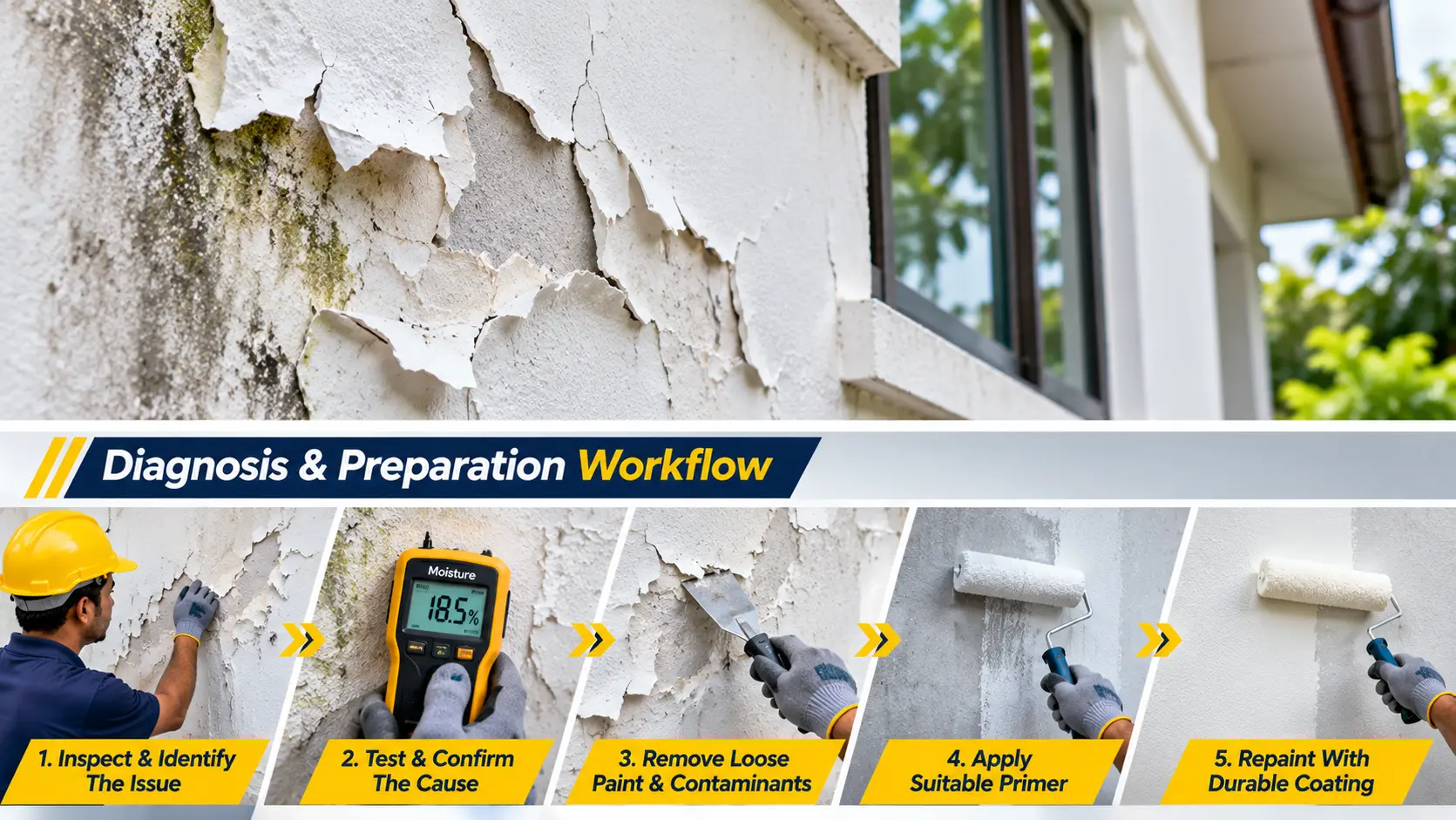
Why Is Paint Peeling Off Exterior Walls, and What Should You Do?
November 11, 2026
Steel Fabrication and Installation in Singapore: Applications, Quality and Safety Guide
November 10, 2026
The Final Renovation Inspection Checklist Every Homeowner Needs
November 9, 2026
How to Create a Realistic Home Renovation Budget in Singapore
November 8, 2026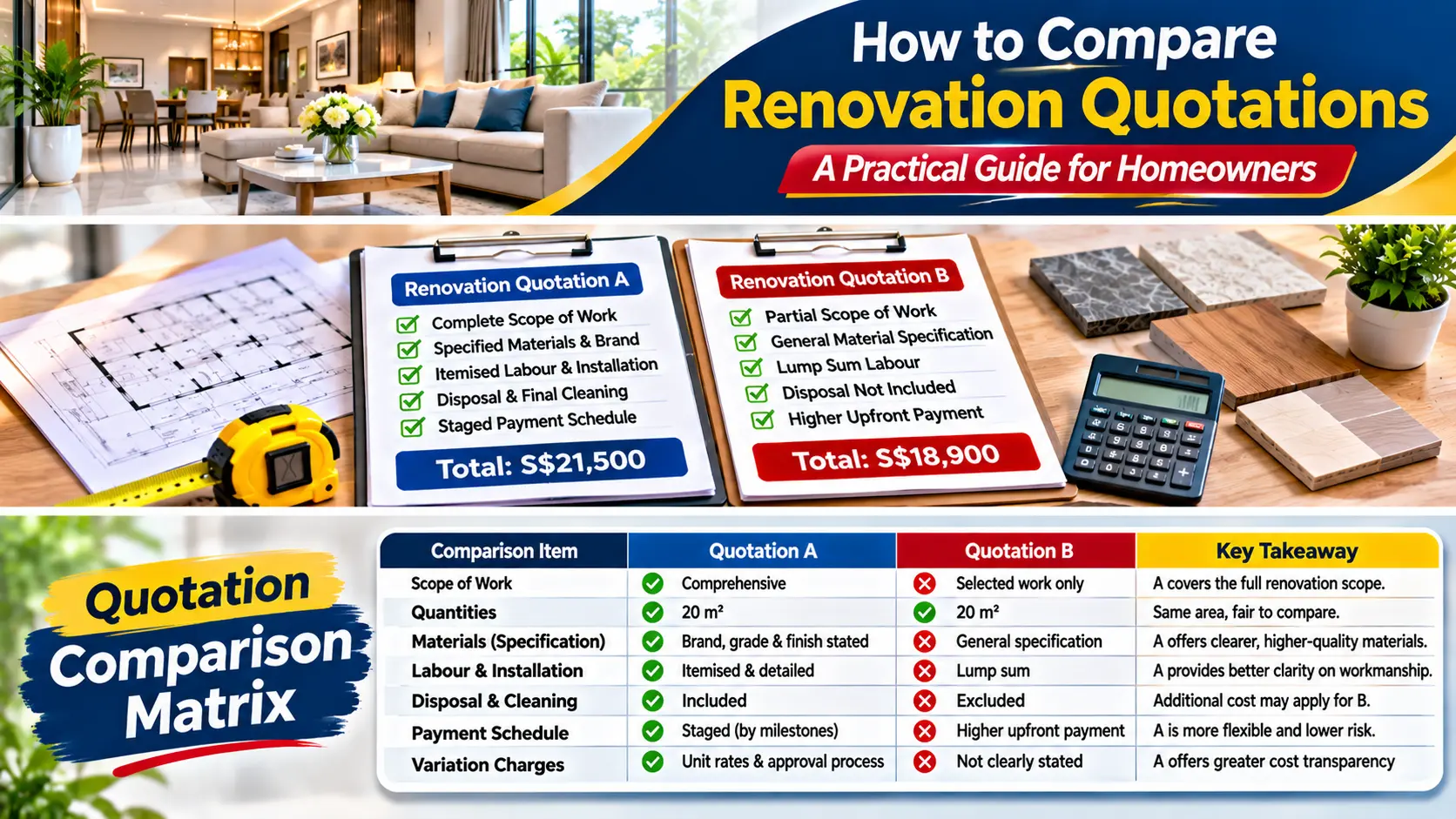
How to Compare Renovation Quotations in Singapore: A Practical Guide for Homeowners
November 7, 2026
Home Renovation Mistakes That Can Cost Time and Money
November 5, 2026
Handyman vs Renovation Contractor vs Specialist Tradesperson: Who Should You Hire?
November 4, 2026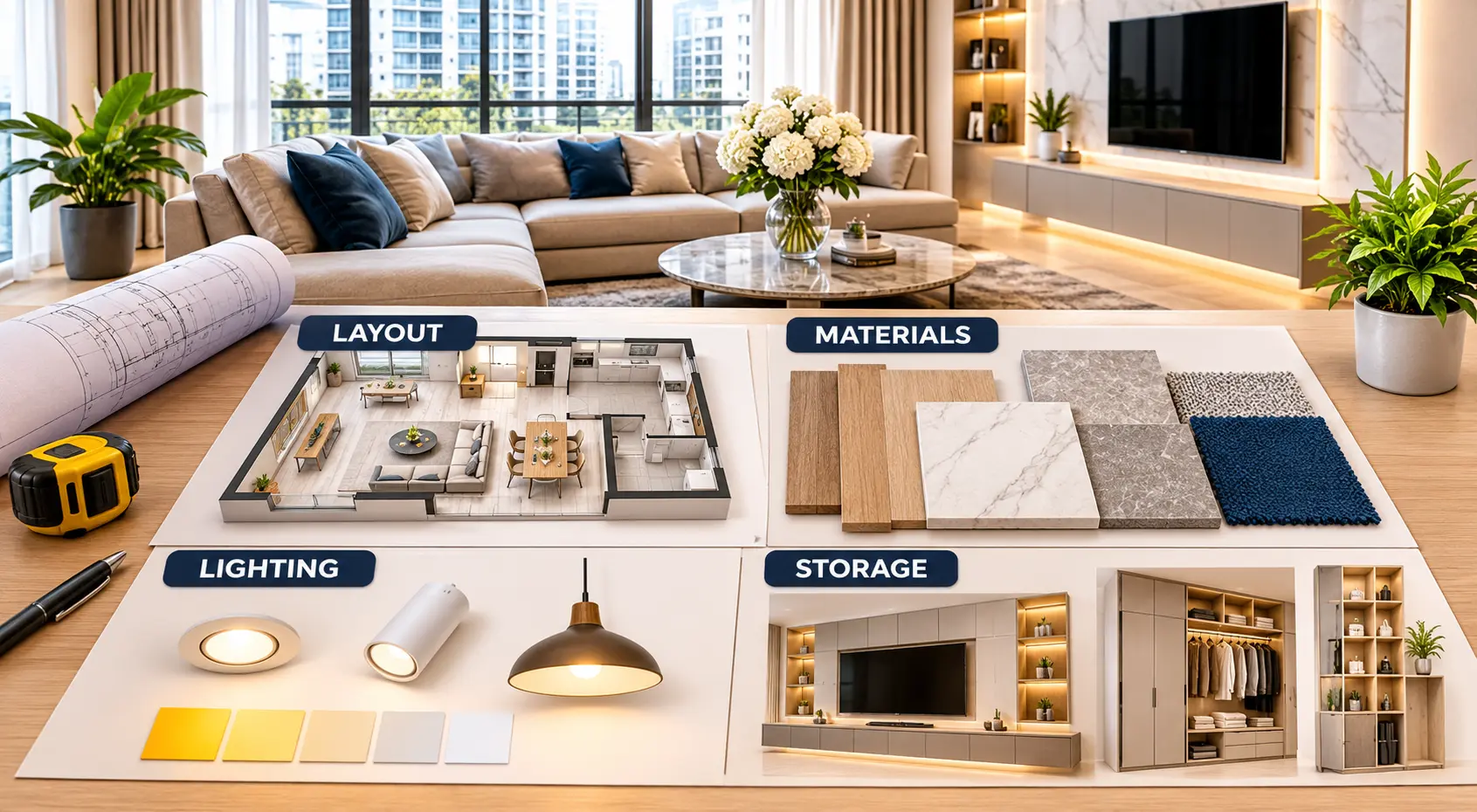
How to Plan a Home Renovation in Singapore: A Complete Guide for HDB, Condo and Landed Homeowners
November 3, 2026